


Today is World Sight Day, which prompts us to consider what transport equity means if you are blind or have vision impairment.
The idea of going somewhere spontaneously or independently can feel daunting if you experience sight loss. That’s why we have funded the Royal Society for Blind Children’s (RSBC) Travelling with Confidence programme.
This summer, on what was probably the only wet day in London, I headed to the RSBC’s headquarters to find out what this meant in real life.
We are funding the RSBC £144,861, over two years, to enhance the mobility and independence of blind and vision impaired children and young people (VI CYP) and their families across England and Wales.
Through a combination of in-person and online support, participants will gain practical tools and confidence to make a difference to their everyday lives.
Building independence together
Part of the grant covers the role of Habilitation Specialist, Rosie Green, who is delivering one-to-one training and group workshops. During my visit, I was invited to shadow a mobility session Rosie was holding with 22-year-old Kaitlin.
When we met, Kaitlin described her sight loss:
"I grew up not having any vision in my left eye. In my right eye, I had some vision, but when I was 19, I had emergency surgery for a retinal detachment. It’s made everything quite difficult, like getting out, and I can no longer read and write the same. I can use my phone by making the text much bigger."
Kaitlin explained that a lack of appropriate support at school and poor mental health led her to leave the education system in Year 9. Social isolation followed.
Currently, she relies on her parents to drive her everywhere. Maintaining friendships has been difficult. However, the RSBC, has given both Kaitlin and her family renewed hope.
Through the organisation, she has made a close friend. One of her goals is to travel independently to visit her and attend a music concert together. Kaitlin loves music. One day, she hopes to go to college and even get a job, too.
Getting streetwise
To work towards these goals, Rosie has been doing some remote training with Kaitlin in Essex, where she lives with her mum and dad. They have been practising road crossings, via video calls.
Rosie told me she does a lot of mobility sessions with young adults over Facetime and WhatsApp.
"Depending on their functional vision, they'll hold the phone themselves, or a family member might assist them, so I can give verbal prompts over their device."
The session I joined, however, involved some white cane training on London's busy streets, as well as some escalator practice in the Underground.
Before we left, I grabbed an umbrella and Kaitlin unfolded her white cane. This cane was funded by the grant.
Rosie said: "They cost between £60 and £70, which is a lot of money for families. After assessing her needs I was able to provide Kaitlin with a new cane and make sure she was using it correctly. She had outgrown her previous one."
As we left the building, Rosie reminded Kaitlin about the diagonal cane technique. This involved holding the cane across her body to detect obstacles and protect herself from hazards ahead. Like puddles.
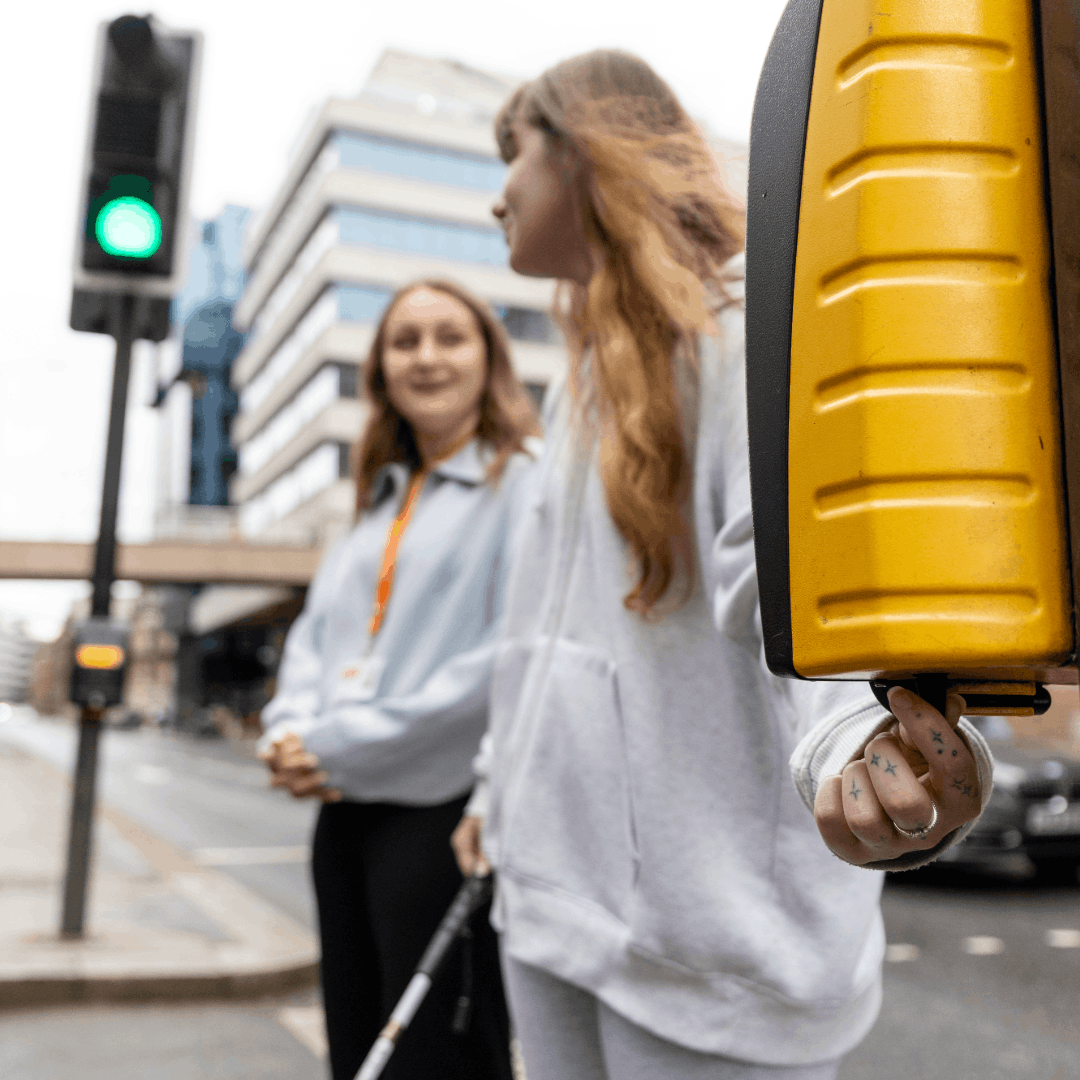
We practised a method called a "parked car crossing". And, as we moved through the streets, Rosie pointed out features that many pedestrians pass without noticing. A series of raised rounded bumps underfoot is called “blister paving."
Combined with a dropped kerb, it signals a pedestrian crossing point.
To cross safely, Kaitlin had to first locate a push-button unit, mounted on a traffic light pole. But just as she placed her hand underneath the black-and-yellow control box, some emergency sirens started getting louder. Despite the rotating tactile cone indicating it was safe, the noisy police car told us otherwise.
Going underground
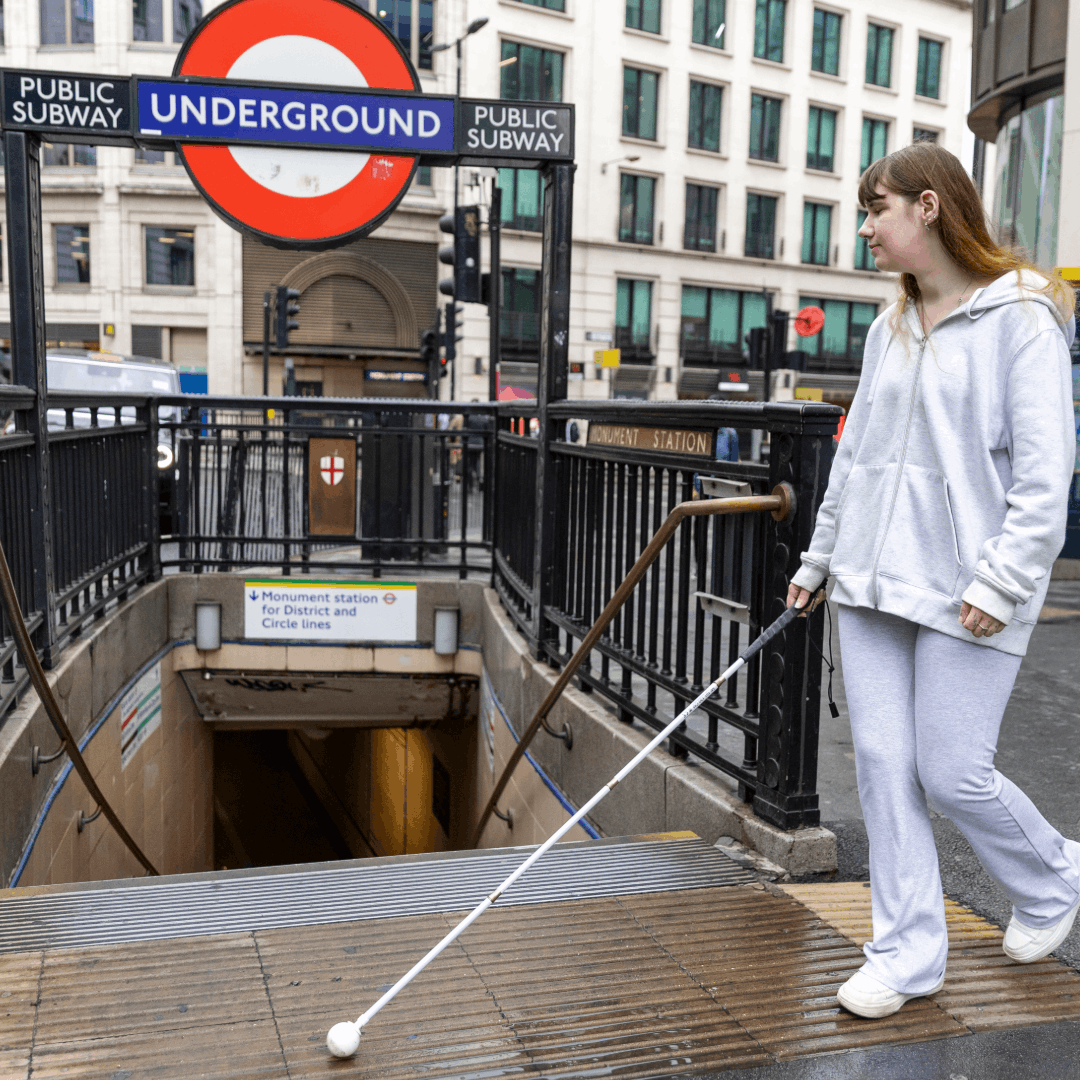
At the Tube station, crowds flowed steadily in and out of the entrance. Once again, the texture changed beneath our feet. Corduroy tactile paving feels ribbed underfoot. Rosie explained that these raised bars warn of hazards such as steps, level changes and railway platforms.
This time, the station we entered was staffed, and Kaitlin could ask an employee to hold the ticket gates open. But assistance won't always be available.
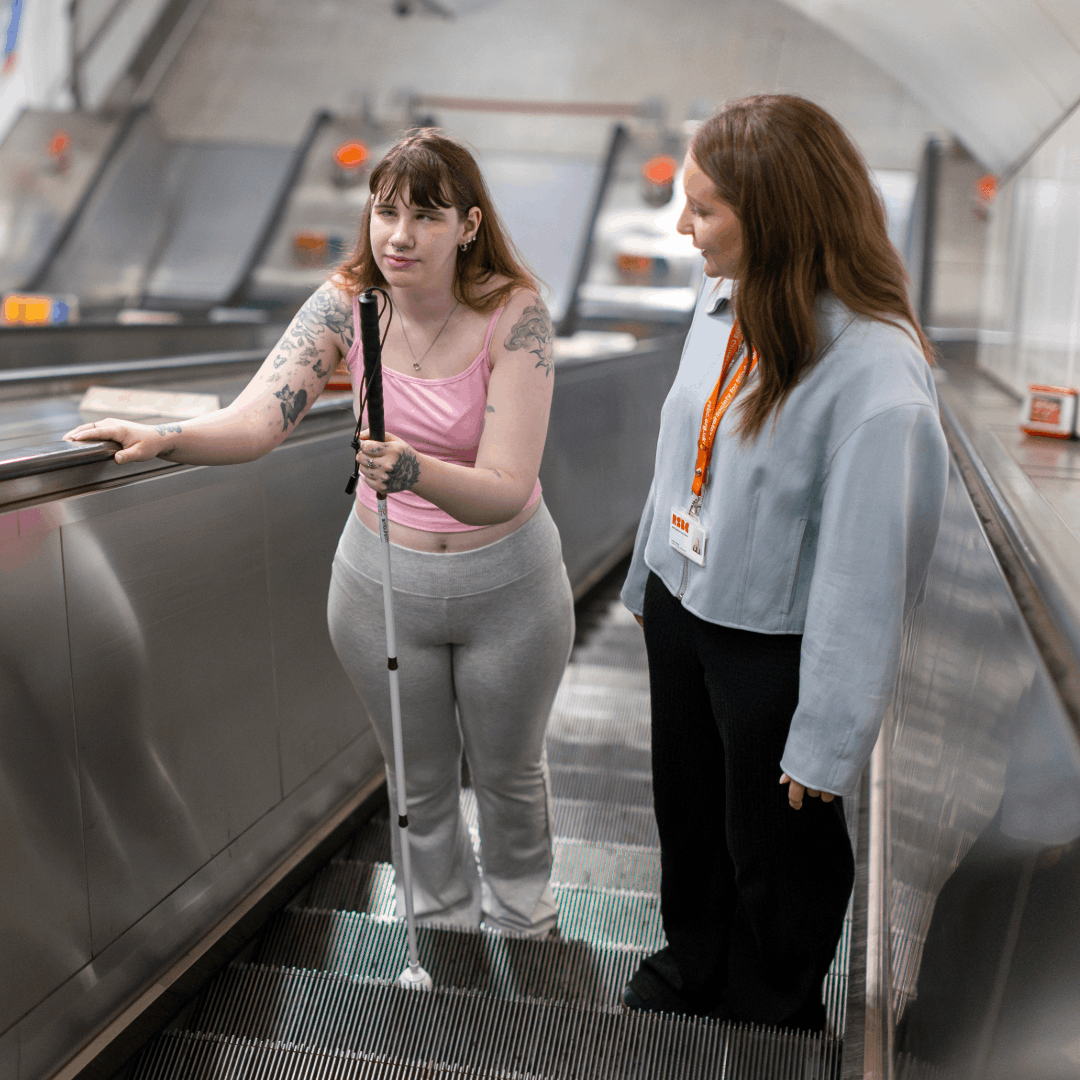
Inside, the metallic ribbing on the ground suggested we were approaching the stairwell. It was Kaitlin's first escalator lesson. If she was nervous, it didn’t show. If anything she was excited to get going.
"There are a lot of escalators at The O2 in Greenwich, so I want to learn how to do it independently," she said. "I'm going to Ariana Grande's next gig there, so the practice will be useful."
Rosie guided her through the process before they set off.
"Find the handrail with your right hand and place your cane diagonally two steps ahead."
As we neared the bottom, Rosie shared a tip that I made a point of remembering for my own nervous 8-year-old.
"Point your toes upward when the escalator starts to level out. This means you slide off without hitting them on the lower bar and stumbling."
Some of the commuters were more considerate than others but Kaitlin wasn't phased. She practised travelling up and down several times, before Rosie decided we had achieved enough. Boarding a train is a lesson for another time.
One step closer to the O2
Back at the centre, where Kaitlin's parents were waiting for her, the rain had finally stopped. Rosie said she was proud of everything Kaitlin had achieved in the six months they have been working together.
Everyone agreed she is well prepared to tackle the O2. Not independently just yet, but I am confident with Rosie’s support, one day she will.